
October 15, 2025
Maheen Fatima
Comments Off on TEMPORARY VS. PERMANENT STAFFING IN SAUDI ARABIA MARKET
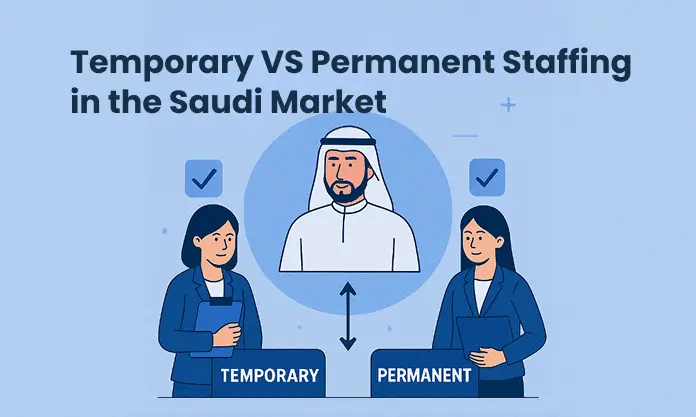
The composition of the Saudi Arabian workforce is currently changing very fast due to the influence of vision 2030, globalization and technology change. One of the most important choices employers can take in as the organization adjusts to the evolving needs of the market is whether to employ temporary employees or permanent employees. The two methods have their own advantages and issues and comprehending the appropriate one could be the key to continuing the development and performance of the organization.
We are going to discuss temporary versus permanent staffing in Saudi Arabia, their benefits and limitations, and how organizations can choose optimal staffing policy in this blog. Another aspect that we shall also bring to light is the value of professional recruitment services in assuring adherence to the Saudi employment contract and the Saudi employment law that regulates hiring in Saudi.
THE IMPORTANCE OF STAFFING IN SAUDI ARABIA:
The transformation in the labor market of Saudi Arabia has one of the most rapid transformations, supported by national and foreign investment. The Vision 2030 strategy of the country should focus on diversification, enhancing the economic power of the domestic sector, and offering more opportunities to the population. This has posed a two pronged challenge:
- Exceeding the demand of professionals in the industries, such as oil and gas, construction, technology, health care, and renewable energy.
- Meeting the local labor laws and Saudization policies even during the recruitment of local and international talent.
In this respect, businesses are in need of a dynamic and flexible personnel solution. The whole decision on temporary and permanent staffing in Saudi Arabia can affect the working efficiency, output cost and long-term planning of the workforce.
TEMPORARY STAFFING IN SAUDI ARABIA MARKET:
WHAT IS TEMPORARY STAFFING:
Temporary staffing refers to a process of getting employees who have been employed on a short-term basis and in most cases through a staffing agency or on contract by a third party. Such workers operate on the definite Saudi employment contract where the term of employment, roles, and payment are usually put down.
ADVANTAGES OF TEMPORARY STAFFING IN SAUDI ARABIA:
- FLEXIBILITY: Temp staffing is a fast way to move in and out workers based on the needs or peak periods of demand in a project. An example is that during the Hajj season, the hospitality and transport industry sees a boom in demand and has to depend on temporary workers.
- COST-EFFICIENCY: Because is not required of temporary as permanent employees the same long-term benefits, employers save money on the cost of final contents and long-term insurance and contributions to the retirement.
- DEMAND-DRIVEN SPECIALIZED SKILLS: Temporary work personnel allow firms to recruit specialists to perform one-time work, that is, IT specialists to enable a digital transformation initiative, or engineers to perform construction steps.
- REDUCED HIRING RISK : The employers will be able to test the employees during the temporary assignments before they are motivated and hired to that permanent position.
CHALLENGES FOR TEMPORARY STAFFING IN SAUDI ARABIA
- RESTRICTED LOYALTY AND INTEREST: Temporary employees are not so interested in the long term objectives of the firm.
- TRAINING COSTS: As temporary workers might be employed only during a relatively short time the training investments might not provide long-term results.
- TURNOVER CONCERNS: A constantly evolving staff may create disruptive working and team relationships.
PERMANENT STAFFING IN SAUDI ARABIA
WHAT IS PERMANENT STAFFING:
Permanent staffing is defined as employment of an employee on a long-term or indefeasible, Saudi based employment agreement. The Saudi labor law usually provides these employees with extensive incentives such as future benefits related to the end of the service, medical services as well as other allowances.
ADVANTAGES OF PERMANENT STAFFING IN SAUDI ARABIA:
- Permanent workers are more loyal and long-run stable, resulting in a more stable organization’s culture and foundation.
- SKILL DEVELOPMENT: Organizations can invest in the development and training of permanent employees in order to actually grow with the organization.
- EMPLOYER BRANDING: With full employment a company aims a better image as an employer to appealing obligations that help an organization attract high talent.
- STRATEGIC GROWTH: Permanent employees play a social role in enforcement of the strategic business plans and the development of the institutional knowledge.
CHALLENGES FOR PERMANENT STAFFING IN SAUDI ARABIA
1.INCREASED EXPENSES: Employers will have contributions to the long-term salaries, benefits, and allowances that can be high in Saudi Arabia.
- LOWER FLEXIBILITY: When permanent staffing is in place, it becomes difficult to rapidly expand the workforce or employee base to meet the volatility of the business.
3.HIRING RISKS: When an individual is wrongfully hired on a permanent basis it can be quite expensive, in monetary and productivity sense.
STAFFING IN SAUDI ARABIA: LEGAL FRAMEWORK:
Speaking of staffing models, the employers should not violate the rules of the employment within the context of Saudi Arabia. The Saudi Labor Law provides explicit specifics about temporary staffing as well as permanent staffing:
- Temporary Employment: There should be start and shut end dates. During their contractual term, workers have the right of having remuneration, overtime and leave days.
- Permanent Employment: Type of contracts that are not defined as permanent. The benefits that the employees have the right to include are the annual leave benefits, end service rewards and medical covers.
- Saudization (Nitaqat Program): It is required that companies should employ Saudi citizens not only regularly, but also in temporary positions, according to quotas imposed by the Ministry of Human Resources and Social Development.
Also the inability to follow these regulations may lead to fines, so despite the trickiness of Saudi labor law, the professional recruitment service is required to simplify the process.
THE ROLE OF STAFFING SOLUTIONS PROVIDERS:
Deciding on the temporary and permanent staffing in Saudi Arabia can be daunting to the organizations as well as those that are not conversant with local labour demands. It is here that solutions providers of staffing in Saudi Arabia as well as recruitment services come in as a significant player.
HOW STAFFING PROVIDERS HELP:
- Compliance: A compliance with the requirements advanced by Best Integration on terms of employment contracts to suit Saudi laws.
- Access to Talent: Offering pre-screened candidates for both temporary and permanent roles.
- Management cost: recommend to employers the best staffing framework at a relatively low cost.
- Efficiency: Shaving down on hiring time and making the onboarding processes more concise.
- Strategic Guidance: Assistance in creating a balance between the changes in workforce mix of organizations in order to be successful over the terms.
Outsourcing staffing procedures allows businesses to concentrate on their business and still make sure that their employee count is up to speed and matches the minimum of the law.
HOW TO DECIDE BETWEEN TEMPORARY AND PERMANENT STAFFING IN SAUDI ARABIA:
Employers should take in consideration:
- Nature of Work: project or routine role?
- Budget: Is the firm able to sustain long-term benefits, or are short term savings necessary?
- Workforce Strategy: Is the company concerned with flexibility or long-lasting stability?
- Availability of talent: Do you have talented employees that can be hired on a permanent or short shelf basis?
- Compliance Needs: Are there any Saudization quotas which demand Saudi workers?
In many instances, a hybrid workforce model, where both temporary part time employees and permanent staffing apply is the most optimum way out.
FUTURE OF STAFFING IN SAUDI ARABIA:
The need to have flexibility and skilled labor as Saudi Arabia goes on to diversify its economy will grow. The focus areas such as renewable energy, technological, tourism, and healthcare will see considerable growth and will require both temporary and permanent employees.
Recruiters and staffing companies will be at the forefront in developing workforce strategies, to allow business to remain within the regulation, and to guarantee that the business is able to meet emerging talents as and when they rise. With such flexible staffing models, employers will be in a better place to be open to changes in the market and tap into new opportunities.
CONCLUSION:
Both the temporary and permanent employees will have their own roles in the Saudi Arabia labor market. Temporary staffing in Saudi Arabia is flexible, low cost, and offers specific skills, so it suits subject work such as projects or seasonal jobs. Conversely, permanent staffing in Saudi Arabia increases stability, loyalty and long-term growth, and is therefore the key to strategic business positions.
The trick is to know where the organization needs and match with the appropriate solution of staffing and abide by the terms of the Saudi employment agreement. Through the collaboration with the professional recruitment services, organizations have the capabilities to make informed decisions in staffing to decide what performance short-term and long-term.
The compromise in staffing will render the business competitive, resilient, and future-driven as the employment in Saudi Arabia is already being transformed in the context of Vision 2030.
